The “Blips” view of people
Down Cemetery RoadThe “Blips” view of people is Amos Crane’s way of turning human beings into manageable marks in a strategic game. It lets him sort a dangerous situation into roles and possible moves, but the visit to Dinah Singleton reveals its central contradiction: people can be reduced to pieces in his calculations even as their lives determine the whole game.
A game played at a distance
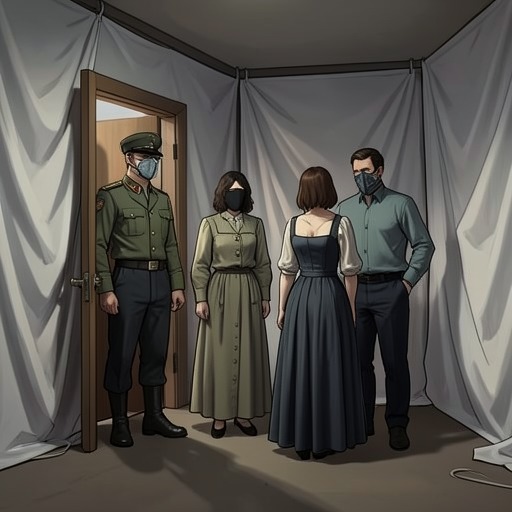
At his desk, Amos Crane had considered the situation from nearly every angle. On the screen, one marker was Nurse, two were Men, and another was Child. Their names and individual features were secondary to the positions they occupied in his mental plan. Even Nurse’s name, Deedee, and the fact that her colouring came from a bottle did not alter her basic status as a blip. The men could likewise be treated as functional types: Amos did not need to put a bag over Muscle’s head to rate him out of ten.
The game metaphor organizes people by what they can do and how they affect the plan. It gives Amos a way to think about the situation without dwelling on each person as a person. Yet the text makes the abstraction concrete by placing the screen’s labels beside details that resist it. The Child has Disney eyes, untidy hair like a feathery cap, and limbs like sticks wrapped in pudgy lagging. These are the visible particulars Amos had not needed when he was calculating at his desk; in the room, the marker has a body.
Why he goes to see her
Amos admits that he had to see Dinah. The repeated thought marks a break in his strategic distance: he had already gamed the situation, and a further practical reason for visiting was unnecessary. He tells himself that he only wanted to look, so that if events changed drastically he would know what the former blips had looked like. The explanation remains consistent with his system—seeing the people supplies information—but the repeated insistence gives the visit a force his calculations cannot account for.
The screen had made Amos feel detached from the other players. Axel was playing King of the Castle in Oxford, Howard nagged Amos when Axel became overexcited, and everyone on the screen seemed more involved than he was, even the child. His visit answers that estrangement by putting him physically in the same space as the people he had treated as pieces. It does not immediately free him from the game’s logic; instead, it shows how readily that logic absorbs even an apparently personal act. Seeing the child becomes a way of preparing for a future change in the board.
The pawn at the centre
Amos recognizes that Dinah is at the heart of events. He compares her position to a pawn reaching the far side of a chessboard and becoming a queen: the child who seemed insignificant can suddenly occupy the center. The comparison records a reversal in strategic value, not a change in Dinah herself. What changes is Amos’s understanding of her place in the contest. Her importance is no longer peripheral or hypothetical; it is the fact around which the other players’ actions turn.
That reversal exposes a limit in the metaphor. A pawn’s promotion is a change of status within a game, while Dinah is a four-year-old whose mother has disappeared. Deedee points out that this is all the child knows and asks Amos to consider whether she would be traumatized. Dinah is quiet and blinks while he watches her; Amos wonders whether she talks at all. The scene gives her silence a human context that the label Child cannot contain, even though Amos’s first response is still to assess what the silence means.
The abstraction’s moral cost
Amos’s thoughts return to the blunt priority of the operation: Dinah could be dead, he reasons, so long as Michael Downey did not think she was. In that calculation, the child’s actual safety is subordinate to her value as something believed to be alive by another player. Amos recognizes this as an aspect of his game that he would be foolish to forget: blips matter more than people. The admission makes explicit the rule the earlier screen imagery had implied. The marker’s function in the plan can outweigh the life of the person it represents.
His handling of the bear and his warning to Deedee bring that rule into the room. Amos says that the bear is for Dinah, tells Deedee to do her job, and warns that whatever happens, the child will be taken away from her. He insists that Dinah looks like a little girl but is no different from a parcel to be guarded. Deedee calls him a bastard. The rebuke marks the human consequence of his language: where Amos recasts a child as an object to be secured and moved, Deedee sees the cruelty of that reduction. The “Blips” view of people thus appears not merely as a private metaphor for strategy, but as a way of making the treatment of living people seem operationally ordinary.